
Athens Concrete Pros · Services
Concrete slab and foundation contractors in Athens, GA
Garage floors, workshop and shed slabs, parking pads, carport and addition slabs, and the footings that carry them. On Piedmont ground the real work is under the concrete: leveling a sloped site, keeping clay dry and dealing with rock when it turns up.
Quick answer
We pour slabs, pads and footings throughout Athens-Clarke County and the neighboring towns. Tell us what the slab has to hold and we visit, take levels across the spot, check the soil and send a free written estimate. The estimate separates the site work from the concrete, so you can see what the ground itself is costing.
Athens soil, slope and weather
Very few building spots in Athens start out level. Making a flat pad on a hillside means cutting into the high side, filling the low side, or both, and fill only works when it is placed in thin layers and compacted, never dumped and poured over. The native red clay is strong when dry and weak when soaked, and it changes volume between the two, so a slab here needs water steered away from it and a stone layer between clay and concrete. Rock is the wild card. Weathered rock or granite can lie just under the topsoil, which is excellent to bear on and slow to trench through for footings. We look for all three, slope, clay and rock, before quoting.
How we do it
- 1
Ask what it carries
A mower shed, two cars, a vehicle lift or a framed addition all call for different slabs. We also ask whether it will be closed in and conditioned, because that changes what goes underneath.
- 2
Shoot levels and probe
A laser level tells us how far the ground falls across the pad. A probe rod and a couple of test holes tell us about topsoil depth, old fill, stumps and rock.
- 3
Cut, fill and compact
The high side is cut, the low side is built up in compacted layers, and the whole pad is topped with crushed stone. Spoil that is not needed for grading leaves the site.
- 4
Trench footings and set forms
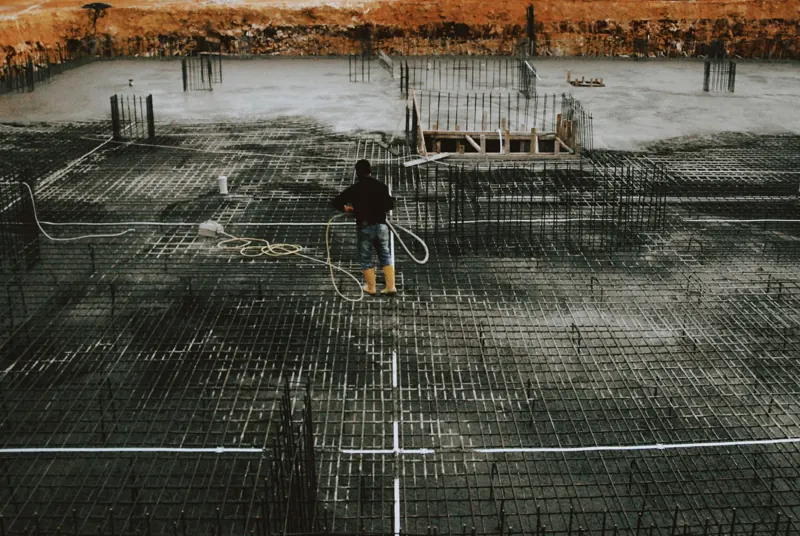
Perimeter and post footings are dug to firm ground, or pinned to rock where rock is what we find. Forms are set square and level and checked on the diagonals.
- 5
Barrier, steel, sleeves, pour
Enclosed slabs get a vapor barrier. Rebar or mesh goes on supports, plumbing sleeves and anchor bolts are placed from your drawings, and the concrete is placed and struck off.
- 6
Finish, joints and curing
Indoor floors are troweled hard and smooth, outdoor pads are broomed. We cut joints, cure the slab and give your builder the date framing can start.
Options and finishes
Garage and workshop floors
Smooth troweled floors with a slight pitch to the door, jointed around posts and ready for a coating later if you want one.
Shed and outbuilding slabs
Slabs with thickened edges and anchor bolts set to the building supplier's layout, so the kit goes straight on.
Parking pads for rentals
Reinforced pads beside or behind rental houses, built for daily use by several cars and tied properly into the existing driveway.
Carport, camper and trailer pads
Heavier reinforced sections for vehicles that sit in one spot for months, with a sound approach so wheels do not break the edge.
Addition and porch foundations
Footings and slabs poured to stamped drawings, with inspections arranged in the right order.
Equipment pads
Level pads for generators, heat pumps and tanks, raised slightly so storm runoff passes around them.
What's in our estimate
Every estimate is written, itemized and free. For concrete slabs and foundations it covers:
- Site levels, layout and squaring
- Stripping, cut and fill, compaction and stone
- Footings and forms as the job requires
- Vapor barrier under slabs that will be enclosed
- Reinforcement, anchors, concrete and placing
- Finish, cut joints and curing
- Permit pulled by us when the slab needs one
What moves the price
- Footprint, thickness and amount of steel
- How far the site falls and the cut and fill needed
- Rock in footing trenches
- Clay that must be removed and replaced
- Footings, thickened edges and anchor hardware
- Vapor barrier for enclosed slabs
- Drawings, permit and inspections
- Truck access or a pump
We don't publish Athens prices: the site decides them, so we measure first. Where this page quotes a figure it is a national range from a named source, listed at the bottom.
Why Athens homeowners call us
Nothing hidden in the price
The estimate lists thickness, stone base, steel, finish and removal separately. Put another quote beside it and the gaps show.
We ring back the same day
As a rule on the same working day, to go over the job and settle a time for the visit that fits your week.
Insured, permits included
Liability insurance on every crew, with the certificate attached to your estimate. If the job needs a permit, we apply for it.
Frequently asked questions
What is a typical price for a slab?
+
Homewyse listed a basic installed slab at roughly $10.63 to $13.00 per square foot in September 2026, assuming an easy, level site. Athens sites are often neither, so grading, footings and any rock work are shown as separate lines on our estimate, on top of the slab itself.
Is rock under the slab a problem or a benefit?
+
Both. Rock is a firm thing to build on and will not shrink or swell. The cost comes when footings or plumbing trenches have to pass through it. We adjust the design where we can, for example by raising the pad, so less rock has to come out.
How do you level a pad on a hillside?
+
By cutting the uphill side and filling the downhill side with material compacted in layers. When the drop is large, we thicken and deepen the downhill edge or build a short foundation wall there, so the slab is not resting on a tall wedge of fill.
Why not pour straight onto the clay?
+
Because clay moves. It swells when it takes on water and shrinks in a dry spell, and a slab sitting directly on it gets lifted and dropped unevenly. A compacted stone layer, good surface drainage and reinforcement let the slab ride through those cycles in one piece.
Who issues the permit for my slab?
+
It depends where the property is. Athens and Clarke County are a single unified government, Winterville is its own city, and Oconee County has separate offices for Watkinsville and the Oconee side of Bogart. Slabs that carry a building normally need a permit. We work out which office applies and pull it.
Can a landlord order a parking pad without being on site?
+
Yes. Many of our customers own houses near campus and live elsewhere. We meet a property manager or work from photos and a site visit of our own, send the written estimate by email, and schedule around the tenants and around home-game weekends.
What to have ready
None of it is required to send the request. It just makes the callback shorter and the estimate more accurate.
- The property address, so we can check the permit office and get the right crew
- Rough dimensions: pace it out or measure the longest and widest points
- What it's for: cars, a work truck, a hot tub, a shed, foot traffic
- A couple of photos of the area and the route a concrete truck would take
- Anything you've noticed about water: puddles, a downspout, a low corner
- When you'd like it done
Where we do slab or foundation work
Other concrete work we do
Sources
- Cost to Install Cement Slab, Homewyse (September 2026 figures)
- What is curing?, American Concrete Institute (checked October 6, 2026)